A Practical Guide for Families Navigating Care Decisions
Choosing a home care provider for yourself or someone you love can feel overwhelming. There’s paperwork, unfamiliar terminology, and high-stakes decisions — all while you’re trying to keep your loved one safe, comfortable, and supported.
You’re not alone in this.
Many families aren’t sure where to start or how to compare agencies. This guide explains how to choose a home care provider in Minnesota and Wisconsin, so you can understand your options, prepare for your homecare interview, and choose care that truly fits your loved one’s needs.

Common Myths About Homecare
Many families delay getting help because they’re unsure what home care really includes. Clearing up a few misconceptions makes the whole process easier.
Myth 1: “Homecare is only for very sick or end-of-life situations.”
Reality: Home care supports people across a wide range of needs — short-term recovery, ongoing support for chronic conditions, pediatric support, or long-term medically complex care.
Myth 2: “Homecare means losing independence.”
Reality: Good home care protects independence. Caregivers and nurses take on the tasks that feel overwhelming or unsafe, so you or your loved one can maintain as much autonomy as possible.
Myth 3: “Homecare is too expensive.”
Reality: Costs vary, and many Minnesota and Wisconsin families qualify for Medicaid waivers, state programs, or insurance-covered nursing. Often, part-time support at home is more affordable than facility care.
Myth 4: “Caregivers are not trained.”
Reality: Reputable homecare agencies provide background checks, structured training, ongoing supervision, and professional nursing staff when medical needs are present.
Myth 5: “Home care agencies only help with daily tasks.”
Reality: While some agencies focus on meals, bathing, mobility, and companionship, many homecare agencies in Minnesota and Wisconsin also provide clinical home health services like skilled nursing visits and private duty nursing.
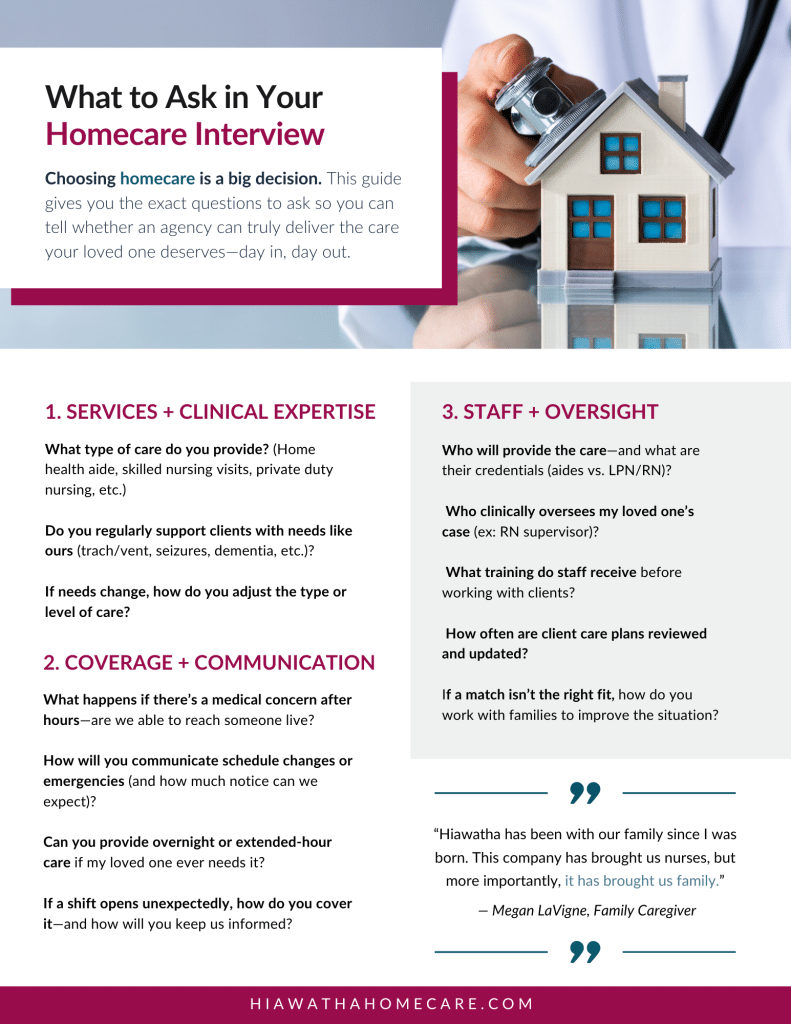
Get Your FREE Backpocket Guide

Understanding the Types of Homecare Services
Once you understand that home care can include both daily support and clinical nursing, the next step is identifying which type your loved one needs. Most homecare providers in Minnesota and Wisconsin offer one or more of the following services:
1. Private Duty Nursing (PDN)
Extended-hours, one-on-one nursing for people with complex medical needs such as ventilator or tracheostomy care, feeding tube support, seizure management, and continuous monitoring.
Who PDN helps:
- Medically fragile children
- Adults with chronic respiratory or nutritional needs
- Anyone requiring hours of skilled nursing each day
2. Skilled Nursing Visits (SNV)
Short visits from a nurse for specific medical tasks — wound care, IV therapy, medication oversight, blood draws, or post-hospital support.
Who SNV helps:
- People recovering after surgery or illness
- Adults managing chronic or terminal conditions
- Seniors or other individuals needing periodic medical oversight
3. Non-Medical Homecare
Support that helps individuals stay safe and independent at home, including physical and occupational therapy, or assistance from a Home Health Aide with bathing, grooming, mobility, and daily tasks.
Who PT, OT, and HHA help:
- Older adults aging in place
- People recovering from injuries or major medical events
- Individuals with chronic conditions like Parkinson’s or MS
- Adults with developmental or neurodivergent needs
Why this matters when choosing a homecare provider
Not all providers offer all service types. Understanding what your loved one needs helps you avoid calling agencies that simply aren’t structured for your situation.
What to ask in your homecare interview:
- ““Which of these service types do you provide?”
- “Do you have experience with clients who have needs similar to my loved one’s?”
- “If my loved one’s needs change, how do you adjust the type or level of care?”
- “Would our situation require PDN, Skilled Visits, or non-medical support?”

Who Delivers the Care – and How They’re Supported
One of the biggest differences between home care providers is who actually comes into your home.
1. Agencies that provide non-medical home care typically staff:
- Personal Care Aides (PCAs)
- Home Health Aides (HHAs)
- Companions
They help with daily tasks, meals, mobility, housekeeping, and companionship, but do not provide medical care.
Agencies providing skilled medical services also employ:
- Registered Nurses (RNs)
- Licensed Practical Nurses (LPNs)
- Licensed Physical/Occupational Therapists
These licensed professionals handle wound care, IVs, injections, tracheostomy/ventilator care, and clinical assessments.
Why this matters: If your loved one needs medical support, you’ll want an agency that employs licensed nurses — not just home health aides — and can clearly explain the qualifications of the person entering your home.
Training, Oversight, and Day-to-Day Support
Agencies differ in:
- How they screen caregivers and nurses
- How much training staff receive
- Whether nurses supervise aides
- How often care plans are reviewed
- How quickly they respond when something isn’t working
A strong agency doesn’t promise perfection – especially in a nursing shortage – but it does have clear systems to address issues quickly, communicate proactively, and support its care teams.
What to ask in your homecare interview:
- “Who will be providing the care, and what are their qualifications?”
- “Is care overseen by an RN or clinical supervisor?”
- “What training do staff receive before working with clients?”
- “How often do you review and update care plans?”
- “If a match isn’t the right fit, how do you work with families to improve the situation?”

How Care Is Paid For
Most homecare agencies in Minnesota and Wisconsin use a blended payment model — private pay, insurance, Medicaid waivers, Medicare (when certified), and VA programs.
A blended model helps agencies serve families with different needs and resources. It also means two agencies may look similar on paper but offer very different coverage options.
What payment sources an agency accepts affects:
- Whether services are covered for your loved one
- How quickly care can begin
- How many hours may be approved
- Out-of-pocket costs
The best homecare agencies will help you understand your options and navigate the process – not push you in the direction that best suits them.
What to ask in your homecare interview:
- “Which payment sources do you accept?”
- “Would my loved one qualify for Medicaid waivers or other programs?”
- “Do you assist families with authorizations or insurance coordination?”
Licensing, Regulation, and Accreditation
Home care agencies follow different rules depending on whether they provide medical or non-medical care — you can save time up-front by knowing what you need for your unique circumstances.
- If your loved one needs medical care at home: Look for an agency licensed for skilled home health services, which ensures RN oversight, clinical protocols, and regular inspections.
- If your loved one needs daily support only: A non-medical home care license is appropriate — lighter regulation, but completely suitable when clinical tasks are not required.
Remember: Many full medical home health agencies also offer non-medical services, but not all non-medical agencies offer medical care.
Questions to ask in your homecare interview:
- “Are you licensed to provide skilled nursing?”
- “Do you also offer non-medical support?”
- “How often are you inspected or audited?”
- “Are you accredited? If so, by whom?”

What makes a high-quality homecare agency?
Once you understand the type of homecare your loved one needs, the next step is choosing an agency that can deliver that care safely, consistently, and compassionately. Many families find that once someone is in their home — supporting their routines, their child, their parent, or their partner — the quality of the agency matters more than anything else.
Here are the signs of an agency you can trust:
1. Reliable Availability, Coverage & Emergency Readiness
Great agencies put safety and continuity at the center of their operations. While no provider can guarantee perfect coverage in a nursing shortage, high-quality agencies have systems that help them respond quickly and keep care as consistent as possible.
They offer:
- 24/7 on-call support for urgent questions or sudden changes
- Clear emergency protocols, including how nurses escalate medical concerns
- Structured processes for managing schedule disruptions
- Overnight or extended-hour options for clients with higher medical needs
- Transparent scheduling so families know who is coming and when
This gives families reassurance — not only on predictable days, but on the difficult ones too.
Questions to ask in your homecare interview:
- “What happens if there’s a medical concern after hours?”
- “When a shift is unexpectedly open, how do you communicate and respond?”
- “Do you offer overnight or extended-hour care if my loved one ever needs it?”
2. Responsiveness and Thoughtful Caregiver/Nurse Matching
Homecare is deeply personal. A strong agency understands that the right fit affects safety, comfort, and long-term stability.
High-quality providers focus on:
- Timely problem-solving when needs or routines change
- Intentional matching based on personality, clinical skill, and family preferences
- Opportunities to reassess a match if it isn’t working
- Regular RN or care coordinator check-ins to tune the care plan proactively
This creates trust and minimizes disruption over time.
Questions to ask in your homecare interview:
- “How do you match caregivers or nurses to clients?”
- “If something isn’t working for our family, what does your adjustment process look like?”
3. Strong Clinical Expertise & Staff Support
For families with medical needs, the agency’s clinical expertise is one of the most important differentiators.
High-quality agencies demonstrate:
- Skilled RNs and LPNs experienced with medically complex conditions
- Robust onboarding and ongoing training requirements
- RN supervision and regular care plan reviews
- Clear delegation procedures and safety protocols for high-acuity clients
This is where the difference between “sending a caregiver” and delivering professional homecare becomes most apparent.
Questions to ask in your homecare interview:
- “What clinical experience do your nurses have with needs like my loved one’s?”
- “How do you train and support your staff, especially for complex care?”
4. Office Support, Communication & Family-Centered Care
A strong homecare experience depends just as much on the agency’s office support as the care delivered in the home.
High-quality agencies offer:
- A responsive office team, not voicemail during critical hours
- Clear, reliable schedules and communication about any changes
- Tools (portals, secure messaging, or routine check-ins) to keep families informed
- A family-centered approach — educating, listening, and collaborating
- Respect for each household’s routines, culture, preferences, and privacy
Questions to ask in your homecare interview:
- “Who should I contact if I have a question or concern?”
- “How will you communicate updates about my loved one’s care?”
- “How do you learn and honor a family’s routines or preferences?”
5. Stability, Continuity & Long-Term Consistency
One of the greatest benefits of homecare is the potential for ongoing relationships. This only happens when an agency invests in stability and values its care teams.
Top-tier agencies demonstrate:
- Lower turnover and long-tenured caregivers or nurses
- Predictable scheduling and minimal rotation
- Practices that support retention and job satisfaction
- Efforts to maintain continuity whenever possible
Continuity builds trust and leads to better outcomes over time.
Questions to ask in your homecare interview:
- “What is your staff turnover rate?”
- “How long do caregivers or nurses typically stay with clients?”
- “How do you support continuity if schedules need adjusting?”
6. Quality Assurance & Transparent Feedback Systems
High-quality agencies don’t just provide care — they evaluate it, refine it, and stay accountable to families.
Look for:
- Satisfaction surveys and open feedback channels
- Public reviews, testimonials, or references
- Clear processes for addressing concerns or changes
- Evidence of quality standards or care improvements
These systems indicate that the agency takes long-term quality seriously — and invites families into the process.
Questions to ask in your homecare interview:
- “How do you monitor quality across your team?”
- “Can you share references or reviews from other families?”
- “If a concern comes up, what is your process for resolving it?”

You Deserve a Homecare Partner You Can Trust
Figuring our how to choose a homecare provider can feel overwhelming. But underneath all the research and questions, what you’re really trying to answer is simple:
Who can I trust with the person I love?
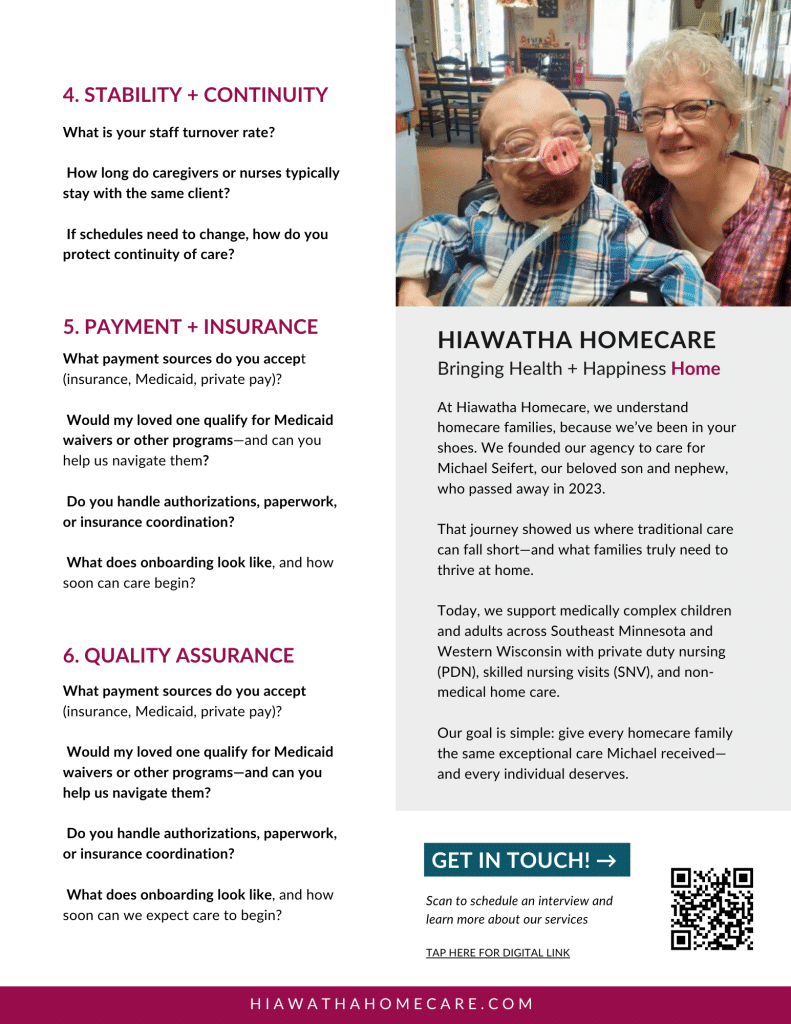
For more than three decades, families across Minnesota and Wisconsin have turned to Hiawatha Homecare for exactly that kind of trust. We’ve lived this journey ourselves, and it shaped the way we care.
We bring together skilled medical care, supportive in-home services, and a team who understands how much home matters. Whether your loved one needs ongoing nursing, short-term recovery, or a partner who can walk alongside changing needs, we’re here to make the path feel lighter.
Families looking for homecare services in Minnesota and Wisconsin deserve clear guidance and a provider they can trust. Not sure where to begin? Let’s talk about what your loved one needs, and how we can help bring health and healing home.
GET IN TOUCH
Schedule a Constultation
FREE GUIDE
What To Ask In Your Homecare Interview
Use this back-pocket guide to prepare for your homecare interview—so you can ask the right questions, compare providers, and choose care that truly fits your family.
Download and keep it handy on your journey. (No email sign-up required!)