A Guide to Keeping Care Going in an Emergency
A power outage or major storm is inconvenient for any household. But when someone relies on medical equipment, medication, or scheduled nursing care, minor disruptions can quickly become a crisis.
Emergency preparedness for homecare families is not simply about stocking flashlights and bottled water. It is about knowing how your loved one’s essential care will continue if the usual routine cannot.
The good news? You don’t have to anticipate every possible emergency. All you need is a clear plan, the right supplies, and a few intentional conversations with your support systems.
1. Know How Essential Care Will Continue
Start by identifying the parts of your loved one’s care that cannot safely be interrupted. With help from their care team, make a written list that includes:
- Medications and treatments that must remain on schedule
- Oxygen, ventilators, feeding pumps, or other essential equipment
- Feeding, respiratory, mobility, toileting, and positioning needs
- Supplies that must always be available
- Changes in symptoms or behavior that require immediate attention
- Tasks a trained family member can safely perform
- Care that requires a nurse, clinician, or emergency medical support
For every essential need, determine how long it can safely be delayed and what to do if that limit is reached.
Do not wait for an emergency to decide whom to call if medication is unavailable, equipment stops working, or your loved one develops a concerning symptom.
What if your homecare nurse cannot reach you?
Severe weather and other emergencies can make travel unsafe for the nurses who care for your loved one. A backup plan can help your family continue essential care without making difficult decisions under pressure.
Work with your homecare team to determine:
- Who to contact if nursing care may be interrupted
- Which family members or caregivers are trained to step in temporarily
- Which parts of care can safely wait—and for how long
- What changes require immediate medical attention
- Where to go if care can no longer be safely provided at home
At admission, Hiawatha assigns each client an emergency priority classification based on their medical stability, care needs, and access to trained support. During a local emergency, this helps our team prioritize clients whose care cannot safely be interrupted.
| Level | Emergency Details |
|---|---|
| Level 1: High priority | The client needs uninterrupted care and may rely on life-sustaining equipment, medication, or highly skilled support. |
| Level 2: Moderate priority | Care may be postponed temporarily with telephone contact and support from a trained caregiver. |
| Level 3: Low priority | The client is stable and has someone available to provide basic care if a scheduled visit is missed. |
| Level 4: Lowest priority | Care may be postponed for 72 hours or longer because the client is largely independent or has a capable caregiver available. |
Your classification should reflect your loved one’s current condition and support system. If their needs change—or a trained backup caregiver is no longer available—contact your Hiawatha care team to discuss whether it should be updated.
Start with this question: Which parts of my loved one’s care cannot be interrupted—and do we have a plan to keep them going?
2. Prepare the Supplies and Backup Power You Need
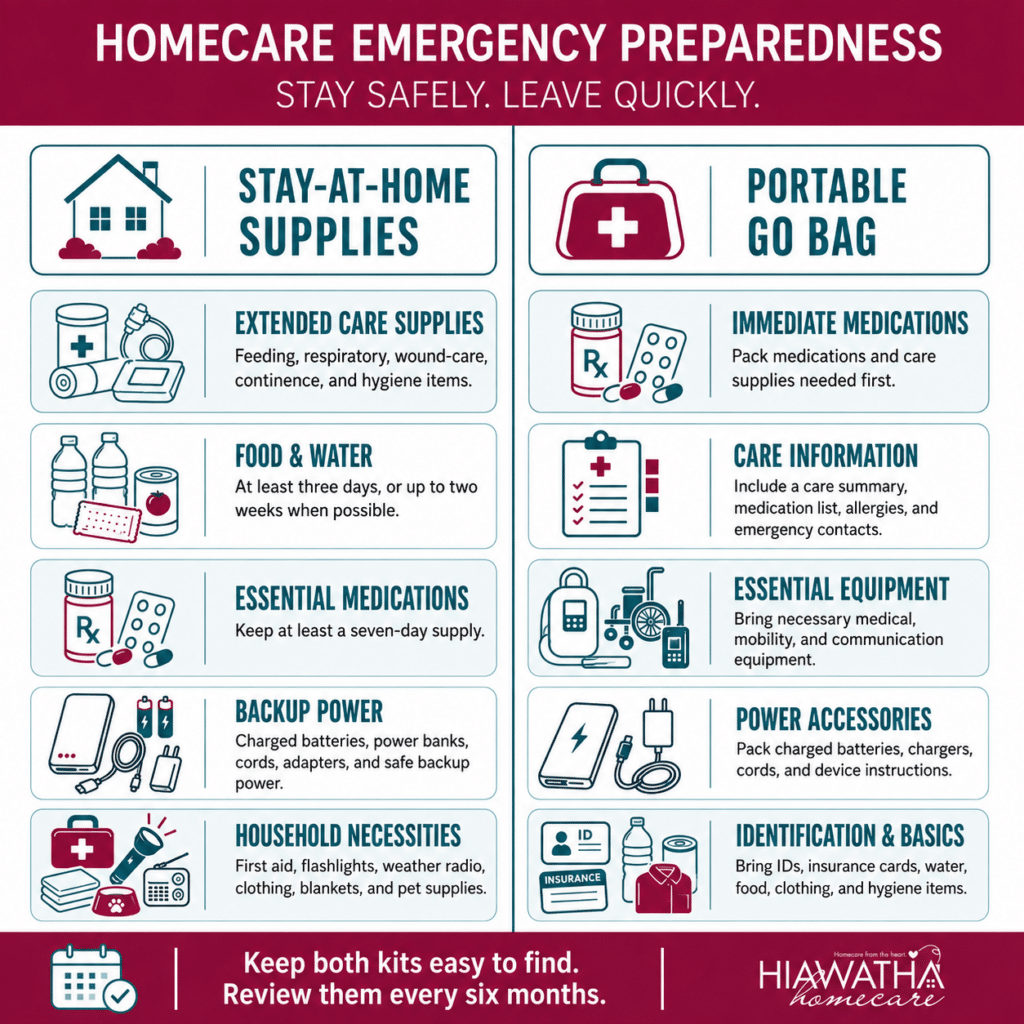
Your emergency supplies should prepare you for two possibilities: remaining safely at home during an extended disruption or leaving quickly with everything needed to continue care.
Prepare to remain at home
Keep at least three days of food, water, medical supplies, and household necessities in one easy-to-find location. When possible, Hiawatha recommends preparing to shelter at home for up to two weeks.
Your supplies should include:
- At least seven days of essential medications
- Feeding, respiratory, wound-care, continence, and hygiene supplies
- First-aid supplies and necessary mobility or communication aids
- Flashlights, batteries, charged power banks, and a weather radio
- Water and shelf-stable food appropriate for your loved one’s needs
- Basic hygiene items, weather-appropriate clothing, and blankets
- Supplies for pets or service animals
Check your supplies every six months and whenever medications, equipment, or care needs change.
Pack a portable go bag
Keep a smaller bag near an exit with the essentials your loved one would need if you had to leave quickly:
- Essential medications and immediate care supplies
- A current medication list, care summary, and allergy information
- Identification, insurance cards, and emergency contacts
- Equipment batteries, chargers, cords, and operating instructions
- Water, appropriate food, clothing, and hygiene items
- Mobility, communication, comfort, or sensory supports
Choose a bag that can be carried alongside your loved one’s necessary medical equipment, and make sure everyone knows where it is kept.
Make a power-outage plan for every essential device
If your loved one depends on powered medical equipment, document each device’s power requirements, backup source, battery runtime, equipment-provider number, and what to do if backup power fails.
Confirm with the clinician, equipment provider, or manufacturer whether the device can safely operate with batteries, a generator, or another power source. Keep the correct cords and adapters nearby and test backup equipment as recommended. After power returns, check that device settings have not reset.
Your plan should also address refrigerated medications. Ask a pharmacist or clinician how each medication should be stored, how long it may remain outside its required temperature range, and when it should be replaced.
Contact your electric utility to ask whether it offers a medical alert or priority-restoration program. Enrollment may help the utility understand your household’s needs, but it does not guarantee immediate restoration or replace backup power.
If you use a portable generator, operate it outdoors, more than 20 feet from doors, windows, and vents—never inside a home, basement, garage, or carport. Keep a working battery-powered carbon monoxide detector inside.
Learn more about generator safety from the CDC.
Most importantly, know how long your loved one can safely remain home without power and what you will do before backup resources run out.
3. Know Where You Could Safely Go
If you ever had to leave home, where could your loved one continue receiving the care they need? Choose one place nearby and another outside your immediate area. That might be a family member’s home, an emergency shelter, or a medical facility.
Before choosing a destination, confirm whether it can accommodate:
- Essential medical equipment and its power requirements
- Oxygen, respiratory, or feeding supplies
- Wheelchairs, lifts, or other mobility devices
- Refrigerated medications
- Accessible sleeping and bathroom arrangements
- A family caregiver or nurse staying with the client
- Pets or service animals
Note: Not every shelter will have the power, equipment, accessibility, or medical support your loved one needs. Contact local emergency management or emergency medical services ahead of time to identify locations that can safely accommodate them.
Your evacuation plan should also identify:
- A primary and alternate route
- Transportation for the client, caregiver, equipment, and supplies
- Someone who can provide backup transportation
- Who will gather medications, documents, equipment, and the go bag
- How you’ll notify Hiawatha and the rest of the care team
Some emergencies require sheltering at home rather than leaving immediately. Follow instructions from local authorities while considering how long essential care can safely continue in your current location.
4. Assign Roles and Practice Your Plan
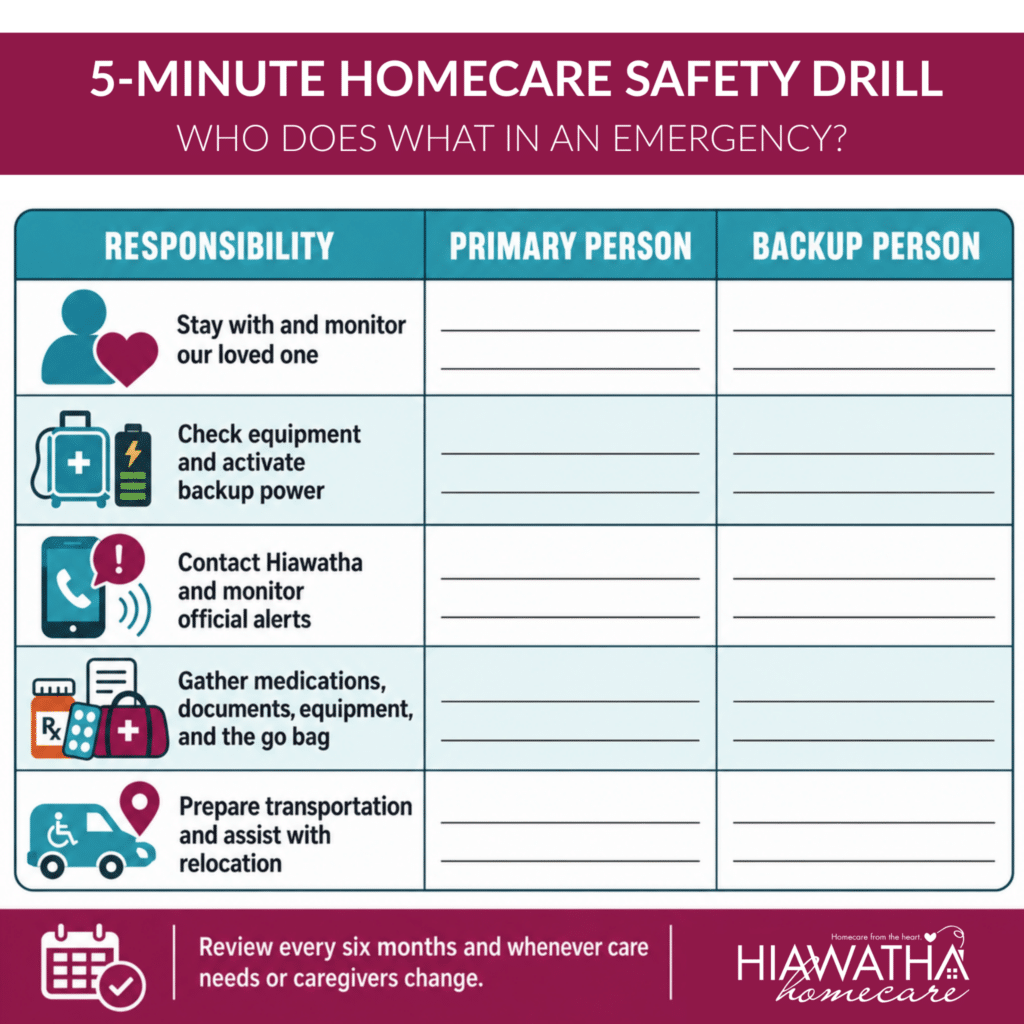
A plan is only useful if everyone knows what to do. Walk through a realistic scenario with your household and any trained backup caregivers before an emergency reveals what is unclear.
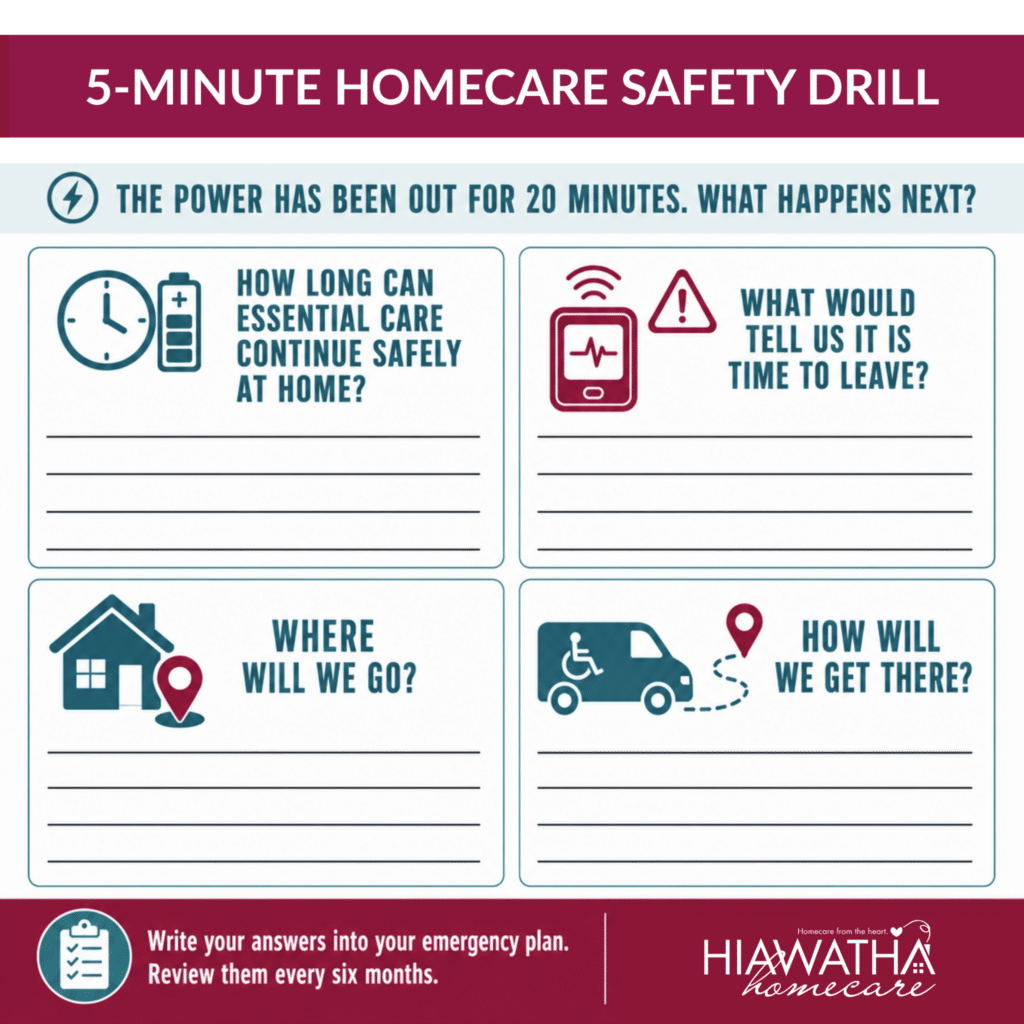
Try this five-minute drill:
- The power has been out for 20 minutes, and you do not know when it will return.
- Who checks the medical equipment
- Who’s in charge of backup power?
- Who contacts Hiawatha?
- Who gathers medications and the go bag?
- How long can care continue safely at home?
- Where will you go if power is not restored?
Use your answers to assign responsibilities. Write them into your emergency plan, so family members do not have to debate who should do what during a stressful moment.
After the drill, update missing phone numbers, replace expired supplies, clarify responsibilities, and discuss unanswered medical questions with the appropriate person on your loved one’s care team.
Repeat the exercise every six months and whenever medications, equipment, caregivers, or medical needs change.
When an Emergency Begins
Follow your loved one’s individualized emergency plan and adjust these general steps to the situation:
- Address immediate danger. Call 911 if anyone needs urgent medical help or faces an immediate threat to life.
- Check essential care and equipment. Confirm that critical devices are working and start backup power if needed.
- Follow local emergency instructions. Monitor official alerts for shelter or evacuation guidance.
- Contact Hiawatha. Let your care team know if care or nursing coverage may be disrupted.
- Gather the essentials. Bring medications, medical information, equipment, and the go bag together.
- Shelter or relocate. Follow your plan before backup resources run out or care can no longer be provided safely at home.
Preparation Creates More Room to Breathe
You cannot control when severe weather, a power outage, or another emergency will disrupt your routine. But you can make sure the people who support your loved one understand which care must continue, where essential supplies are kept, and what to do next.
Review your emergency plan regularly and keep Hiawatha informed when your loved one’s condition, equipment, or available support changes. If you have questions about preparing for an interruption in care, contact your Hiawatha care team.
We are here to help you plan ahead so your loved one can remain as safe and supported as possible at home.