Are you falling out of love with nursing, or just the way you’re being asked to practice it?
When every shift begins with dread, ends in exhaustion, and leaves little room for meaningful patient care, the problem may not be your profession. It may be the pace, pressure, and structure of your current setting.
Here are seven signs your nursing environment no longer fits.

1. You dread your shift before it even begins.
Maybe it’s the tightness in your chest as you pull into the parking lot. The restless sleep before a 12-hour shift. The way your mood changes the moment you put on your scrubs.
After a while, that heaviness can start to feel normal. But often, it isn’t nursing itself that’s wearing you down. It’s the constant uncertainty, the relentless pace, and the feeling that every shift starts with you already behind.
When that dread follows you home, disrupts your sleep, or steals the time you’re supposed to be recovering, it may be a sign that your current nursing environment is taking more than it gives back.
Homecare nursing (also called home health nursing) still has stressful days. But caring for one client in their own home creates a steadier rhythm and more opportunities to build meaningful patient relationships.

2. You spend more time charting than connecting
You sit down to chart, knowing several notes are waiting. Before you finish one, a call light goes off. A medication is due. Someone needs an update. By the time you return, you’re rereading your note to remember where you left off.
Nurses working in hospital and acute care settings spend a significant portion of every shift documenting care. Add admissions, duplicate fields, medication passes, and competing priorities, and it’s easy to feel like you’re documenting nursing more than practicing it.
That wears on you. Not because documentation is unimportant or you’re disorganized, but because it keeps pulling your attention away from the people in front of you. You can work nonstop and still leave feeling like the human part of nursing got squeezed into whatever time remained.
Homecare still requires careful charting. But with one client at a time, many nurses find documentation becomes part of the care instead of the thing consuming it.

3. Your schedule feels like it controls your life.
Before you say yes to dinner with friends, a weekend trip, or your child’s recital, you check the schedule. Again. You hesitate to make plans because you don’t know if you’ll be working. Even requesting a day off can feel like a gamble.
Over time, that uncertainty starts to affect more than your calendar. Rest becomes something you squeeze in between stretches of work. Time with family feels tentative. Your days off become recovery days instead of days that actually belong to you.
Poor work-life balance is one of the most common reasons nurses begin exploring other nursing careers—even when they still love caring for patients. Homecare won’t give you unlimited flexibility. But it can offer more choice around your schedule, hours, location, and client assignment.

4. You keep thinking, “I used to care more than this.”
Maybe you’re less patient than you used to be. You rush conversations you once would have lingered in. A patient asks one more question, and instead of feeling curious, you feel the weight of everything waiting outside the room.
That can be hard to admit. But it doesn’t mean you’ve stopped caring.
Compassion fatigue and moral distress can create a painful gap between the care you want to give and the care your environment allows. When every shift feels rushed and emotionally demanding, patience and empathy can start to feel like resources you have to ration.
Rather than a failure of commitment, this may be a sign that your current work environment no longer fits the kind of nurse you want to be. A setting built around one-on-one care can create room for connection to return.

5. You miss knowing the people behind the patients
You know the room number, the medication schedule, and the latest lab results—but not always the person behind them. You notice the family photos on the nightstand and mean to ask about them. You tell a patient, “I’ll be right back,” then get pulled in five different directions before you can return.
The hardest part isn’t having too much to do. It’s knowing the kind of nurse you want to be—and rarely having enough time to be that person.
If you keep wishing for five more minutes to sit, listen, or simply be present, pay attention to that longing. One-on-one care allows many homecare nurses to build stronger patient relationships, greater continuity, and deeper trust with both clients and families.

6. You’re exhausted—but your heart is still in it.
Maybe you’ve stopped expecting every shift to feel rewarding. You count down the hours until you can go home. And yet, when a patient asks, “Can you stay for just a minute?” you do.
You still explain something one more time because it will ease their fear. Or speak up when someone is being dismissed. Or notice the small details that help patients feel safe and seen, even when you’re running on empty.
Those moments prove your compassion is still there. What’s wearing you down is the strain of giving more emotional energy than your environment allows you to restore.
If you’re exhausted but still care deeply, you may not need to leave nursing. You may simply need a nursing environment where your compassion, clinical judgment, and patient relationships have room to grow.

Is Homecare Nursing Right for YOU?
Maybe you saw yourself in one of these signs. Maybe you saw yourself in all seven. Before you decide you’re done with nursing, pause and ask:
Is it nursing that’s no longer fitting… or the environment I’m practicing it in?
You may not need a new profession. You may need a different pace, a different setting, and more room to give the kind of care you still want to provide.
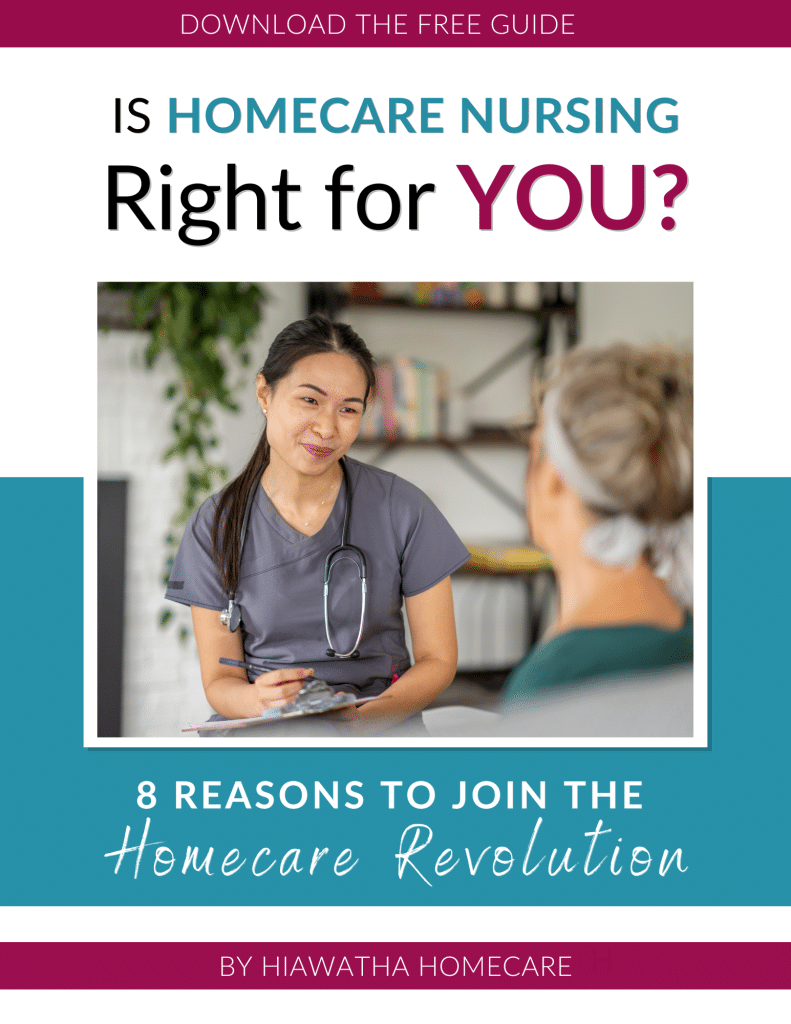
If you’re curious what that could look like, download our free guide Is Homecare Nursing Right for You?
Inside, you’ll find an honest comparison of hospital nursing and homecare nursing, firsthand stories from nurses who’ve made the transition, and practical questions to help you decide whether homecare is the right next step for your career.
Download your free copy today.
FAQ: Homecare Nursing
How do I know if I’m burned out or simply in the wrong nursing environment?
Burnout can happen in any nursing role, but sometimes the real issue is a mismatch between your values and your work environment. If you still care about nursing but feel drained, disconnected, or unable to provide the care you want, it may be worth exploring a different setting.
What are the biggest differences between bedside nursing and homecare nursing?
Bedside nursing often involves caring for multiple patients at once, frequent interruptions, and a fast-moving pace. Homecare nursing typically centers on one client at a time, which can mean more continuity, more independence, and deeper patient relationships. Both require strong nursing skills, but the day-to-day experience is very different.
Is homecare nursing less stressful than hospital nursing?
It can be, but it is not stress-free. Homecare nurses still make clinical decisions, document care, and manage complex needs. The difference is that many nurses find the pace calmer and more predictable because they are not juggling as many competing demands at once.
What does a typical day look like for a homecare nurse?
A homecare nurse usually spends the shift caring for one client in their home. Depending on the client, that may include assessments, medication administration, documentation, patient education, trach or ventilator care, and support with daily routines. Many nurses also build long-term relationships with clients and families.
Will I lose my nursing skills if I switch to homecare?
No. Homecare nursing still requires strong clinical judgment, assessment skills, communication, and problem-solving. In many cases, nurses use a wide range of skills and become the primary clinician supporting a client’s care.
Is homecare nursing a good fit for every nurse?
No. Some nurses thrive in the pace, variety, and teamwork of hospital or acute care settings. Homecare is often a strong fit for nurses who value one-on-one care, independence, flexibility, and ongoing relationships with clients.
Can I move into homecare without leaving nursing?
Yes. Homecare is still nursing. Many nurses move into homecare because they want a different pace, more flexibility, or stronger patient relationships while continuing to use their clinical skills.
Ready to Join the Homecare Revolution?
If you’re looking for greater flexibility, stronger patient relationships, and rewarding RN and LPN jobs in Minnesota or Wisconsin, we’d love to meet you.
Hiawatha Homecare is hiring homecare nurses across Minnesota and Wisconsin. Explore our open positions and discover what nursing can feel like in a different environment.