You finally get into your car after a 12-hour shift, and for the first time all day, it’s quiet.
But you don’t feel relieved.
Your body is still moving at hospital speed. You’re thinking about the patient who crashed after your gut told you something wasn’t right. The family member you tried to comfort while mentally calculating how far behind you were. The call lights, alarms, and admissions that kept coming, no matter how fast you moved.
At some point, you stopped feeling hungry, tired, or even stressed. You just locked in. But now, sitting there with your key in the ignition, the shift catches up to you all at once.
What Causes Burnout in Hospital Nursing?
Nearly two-thirds of nurses report experiencing burnout regularly. That’s not a surprise to anyone working in healthcare. Caring for people through illness, fear, suffering, and loss is emotionally demanding work.
But what many nurses are grieving now is something deeper: the loss of time, presence, and connection inside healthcare systems stretched far beyond capacity.
Most nurses still love nursing. They’re simply depleted by environments that rarely slow down long enough for care to feel complete.
Can Homecare Help With Nursing Burnout?
For many nurses, yes.
Homecare isn’t stress-free. Clients still have complex medical needs. Difficult days still happen. Families still need support.
But homecare naturally removes many of the conditions that drive nursing burnout in hospitals: high patient loads, constant interruptions, emotional multitasking, and the pressure to move faster while caring for more people.
That’s why many nurses who thought they were done with the profession discover they were actually done with the environment.
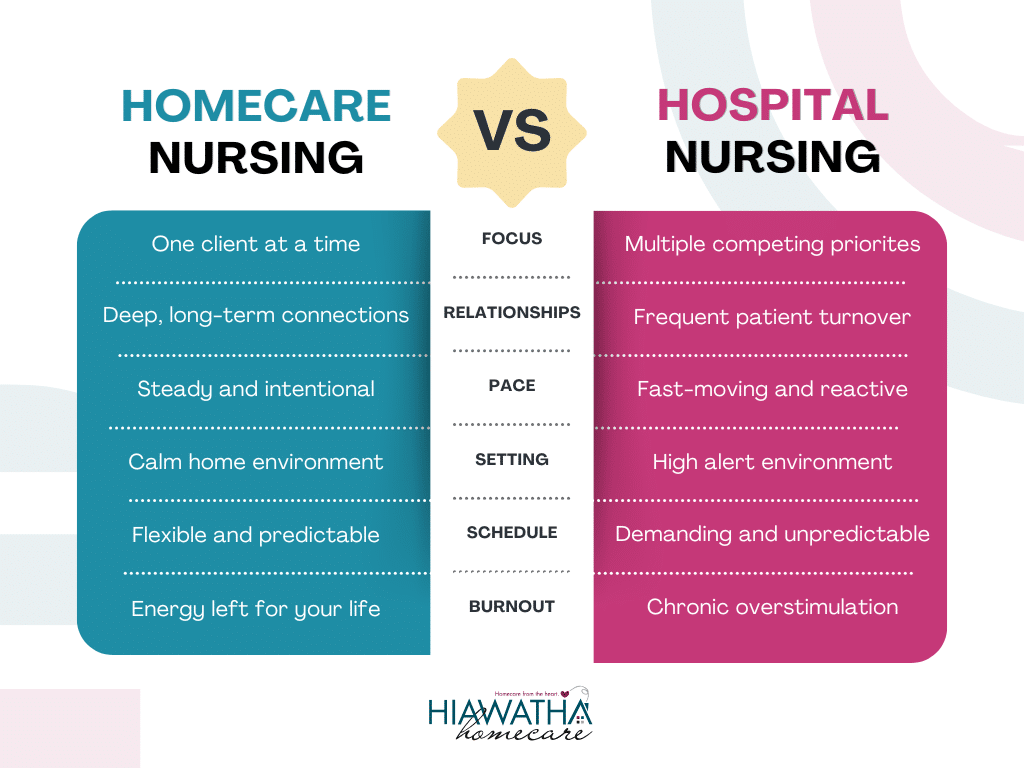
Homecare vs Hospital Nursing: Key Differences
Benefits of Homecare Nursing for Burned-Out Nurses
1. More Space to Focus
In hospitals, your attention is constantly fragmented—charting while fielding physician questions, scanning meds while a bed alarm goes off. In homecare, you care for one client in one home. If you’re doing a trach change, you’re doing a trach change. When a client needs to tell you something, you can give them your full attention. When it’s time to document, you actually have time to document.
It’s quieter, more predictable, and more intentional.
2. Less Emotional Whiplash
One of the hardest parts of hospital nursing is the emotional whiplash—moving from coding a patient to explaining discharge instructions to walking into a room where a family just received devastating news, all within an hour. There’s rarely time to process any of it.
In homecare, the emotional rhythm is different. You’re not moving between strangers in crisis. You’re caring for someone whose story you’re already part of. Most days focus on stability, routine, and helping clients safely live their lives at home.
“I feel far more rewarded by the work I provide one person than I did caring for many. Far less stress and far more time to give to each task.” — Lynn K., Hiawatha Homecare Nurse
3. A Better Work-Life Balance
Hospital nursing can take a toll on your whole body—long shifts on your feet, missed meals, rotating schedules, nights, weekends, mandatory overtime. Even when you love the work, it can start to feel like nursing gets the best of you, and everyone else gets what’s left.
In homecare, the pace is different. You leave knowing your care mattered—but it didn’t drain every ounce out of you.
“I need a high degree of flexibility in a nursing position. I could not get that anywhere else, I am certain.” — Tracy S., Hiawatha Homecare Nurse
4. Deeper Patient Relationships
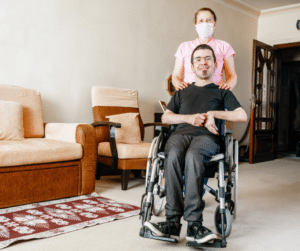
In homecare, you care for one client at a time, often over months or years. You learn their routines, baseline, communication style, and family dynamics. You know when something is off because you know what “okay” looks like.
Over time, you become more than the nurse on shift. You become a trusted part of their care, their household, and their life.
“When my client’s father told me I was the bright spot in their lives… I couldn’t have made it without me!” — Lisa F., Hiawatha Homecare Nurse
5. You Finally See Your Long-Term Impact
Hospital nurses do meaningful work every day—but they rarely get to see the full story. You stabilize a patient, discharge them, and move immediately to the next need.
Homecare lets you witness the impact of your care over time. You see a child who once needed frequent hospitalizations stay home for months. You watch a client grow more confident in a routine. For many nurses, that visibility—seeing the concrete results of your work over weeks and months—restores the sense of meaning that burnout slowly erodes.
“Everywhere could use more nurses, but in homecare you really can feel the value placed on your care and expertise in their lives. They can’t live at home without it.” — Lisa F., Hiawatha Homecare Nurse
Is Homecare Nursing a Good Career Move?
Homecare isn’t the right fit for every nurse, but for burned-out nurses looking for a sustainable alternative to hospital nursing, it offers something most traditional settings can’t: time.
Time to think before acting. Time to complete care without cutting corners. Time to document. Time to recover between stressful moments instead of jumping straight into the next crisis.
It’s still nursing. It still requires skill. It still changes lives. But for many nurses, it no longer feels like survival.
Who Thrives in Homecare Nursing?
The nurses who thrive in homecare are often the same nurses who cared the most in traditional settings; the ones who notice subtle changes, remember family members’ names, and stay a few extra minutes to answer questions.
Homecare tends to be a strong fit for nurses who:
- Value relationship-based care over task-based care
- Want more autonomy in their day-to-day work
- Prefer calmer environments and more predictable stress levels
- Want to see long-term impact rather than short-term outcomes
- Are looking for a way to stay in nursing without burning out
If you’ve ever thought, I still love nursing, but I can’t keep doing it like this, homecare may be worth exploring.
Learn More: Read our blogs Why Homecare is the Best Part-Time Nursing Job and Nursing Jobs for Moms: Why Homecare is the Perfect Fit!
Homecare Nursing Jobs in Minnesota and Wisconsin
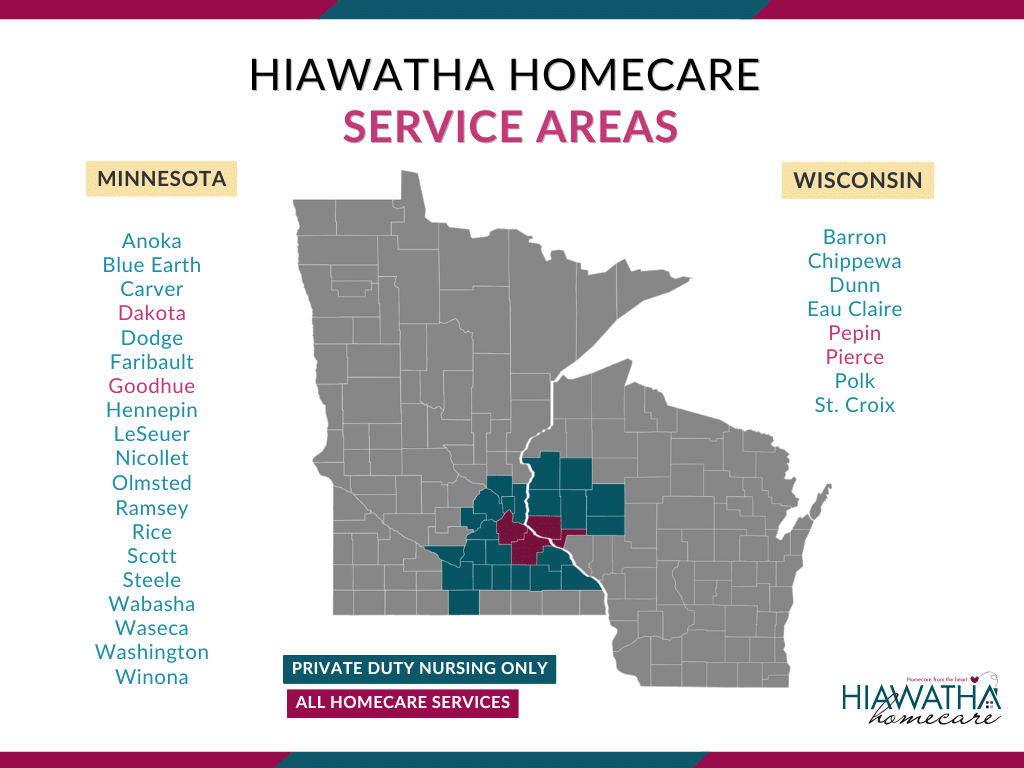
For more than 35 years, Hiawatha Homecare has helped medically complex children and adults across southeast Minnesota and western Wisconsin, including communities in the Twin Cities, Rochester, Eau Claire, and surrounding areas, remain safely at home, surrounded by the people, routines, and communities they love.
We thoughtfully match nurses with clients, provide ongoing clinical support, and create opportunities for long-term relationships that simply aren’t possible in most traditional healthcare settings.
If you’re looking for a way to stay in the profession you love without sacrificing your well-being, explore our current open positions or reach us at (800) 837-8898 or info@hiawathahomecare.com.
Frequently Asked Questions: Homecare Nursing & Nursing Burnout
Is homecare nursing less stressful than hospital nursing?
Many nurses find homecare more manageable because they’re caring for one client at a time rather than managing multiple competing priorities. While homecare still requires clinical judgment and emotional resilience, the pace is more predictable and less fragmented.
What are the signs of nursing burnout?
Common signs of nursing burnout include emotional exhaustion at the end of every shift, dreading going to work, feeling detached from patients, making more mistakes than usual, and a growing sense that nothing you do makes a difference. Physical symptoms like chronic fatigue, headaches, and trouble sleeping are also common.
Is home health nursing a good option for burned-out nurses?
Yes, for many nurses experiencing burnout, homecare addresses the root causes directly—offering more continuity, stronger patient relationships, fewer interruptions, and the ability to see the long-term impact of your care.
What does a homecare nurse do on a typical day?
Homecare nurses provide skilled medical care to clients in their homes. Depending on the client, this may include medication administration, tracheostomy care, ventilator support, assessments, family education, and ongoing monitoring.
Can hospital nurses transition into home health nursing?
Absolutely. Many successful homecare nurses come from hospital, long-term care, and rehabilitation settings. Strong assessment skills, adaptability, and a desire to build relationships are often more important than prior homecare experience.
How much do homecare nurses make in Minnesota and Wisconsin?
Compensation varies by case complexity, experience, and schedule. While homecare wages may be slightly different than large hospital systems, many nurses report the trade-off in quality of life and job satisfaction is well worth it. Contact our team to discuss current compensation.
Where does Hiawatha Homecare provide services?
Hiawatha Homecare serves families throughout southeast Minnesota and western Wisconsin, providing private duty nursing and other in-home care services that help clients remain safely at home.